
AI + IoT Applications for Pharmaceutical Contract Manufacturing
AIoT-based people tracking, access control, asset tracking, inventory control, work-in-progress, and traceability for the Contract Manufacturing industry.
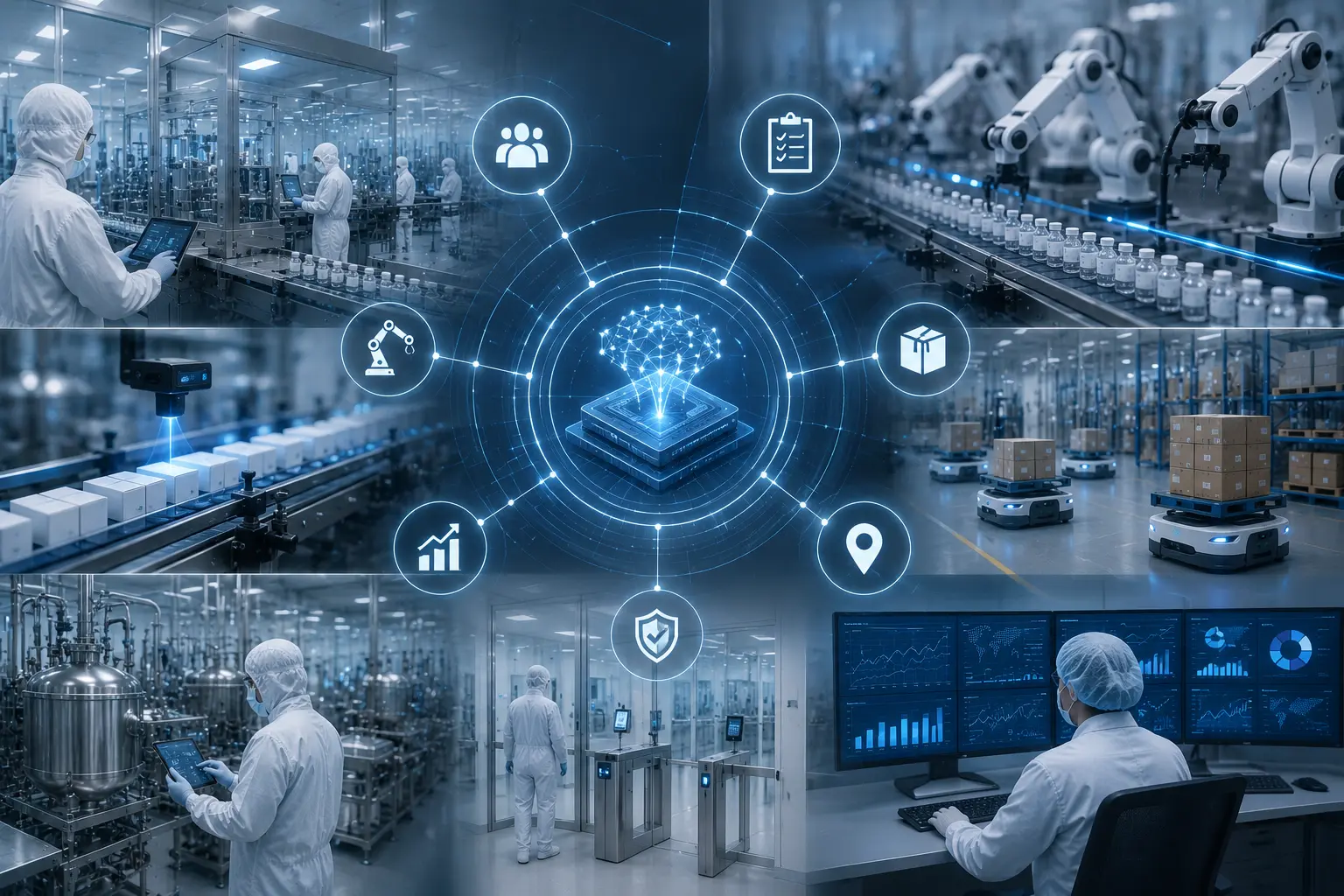
Intelligent AI + IoT Applications Across Modern CMO and CDMO Manufacturing Operations
Pharmaceutical contract manufacturing has evolved into one of the most technically demanding manufacturing environments within the Chemicals & Pharmaceuticals industry. Contract Manufacturing Organizations (CMOs) and Contract Development and Manufacturing Organizations (CDMOs) simultaneously manage multiple customer programs, technology transfers, clinical manufacturing campaigns, commercial production, packaging operations, regulatory documentation, and global supply chain requirements. Every production campaign must comply with current Good Manufacturing Practice (cGMP), GxP requirements, FDA 21 CFR Part 11, EU Annex 11, ALCOA+ data integrity principles, and customer-specific quality agreements while maintaining operational efficiency.
AI + IoT enables pharmaceutical contract manufacturers to transform isolated production data into actionable Operational Solution by connecting personnel, manufacturing equipment, cleanroom environments, warehouse operations, production materials, laboratory systems, packaging lines, and enterprise software. Using RFID, BLE, industrial IoT devices, Edge AI, MQTT, OPC UA, Private 5G, Wi-Fi 6, and industrial Ethernet, manufacturing events can be monitored continuously while intelligent analytics identify deviations, production bottlenecks, equipment utilization trends, inventory shortages, and compliance risks before they impact product quality.
Unlike traditional automation systems that primarily collect machine data, AIoT continuously correlates operational information across manufacturing execution, warehouse logistics, quality management, laboratory testing, environmental monitoring, serialization, and batch genealogy. This enables manufacturing, engineering, quality assurance, validation, and supply chain teams to make faster operational decisions supported by real-time manufacturing System.
ContractMfg AI focuses on practical AI + IoT deployments specifically designed for pharmaceutical contract manufacturing. Rather than replacing validated manufacturing systems, AI + IoT complements Manufacturing Execution Systems (MES), Laboratory Information Management Systems (LIMS), Enterprise Resource Planning (ERP), Warehouse Management Systems (WMS), Supervisory Control and Data Acquisition (SCADA), Electronic Batch Record (EBR) software, and Quality Management Systems (QMS) to improve operational visibility while supporting validated manufacturing processes.
Organizations manufacturing oral solid dosage products, sterile injectables, biologics, biosimilars, vaccines, cell and gene therapies, active pharmaceutical ingredients (APIs), high-potency compounds, and personalized medicines increasingly depend on intelligent AI + IoT solutions to improve batch execution, maintain regulatory compliance, optimize production scheduling, and strengthen supply chain transparency.
AI + IoT Applications Throughout Pharmaceutical Contract Manufacturing
Modern pharmaceutical contract manufacturing requires continuous coordination between production personnel, manufacturing equipment, raw materials, environmental monitoring systems, laboratory testing, warehouse operations, and customer-specific production campaigns. AI + IoT connects these operational domains into a continuously monitored manufacturing environment where intelligent software can identify risks, recommend corrective actions, and improve operational performance.
Unlike discrete manufacturing industries, pharmaceutical production demands complete documentation of every manufacturing activity. Material dispensing, formulation, blending, granulation, aseptic filling, lyophilization, coating, packaging, labeling, serialization, warehousing, and distribution all generate regulated manufacturing records that must remain accurate, traceable, and audit-ready throughout the product lifecycle.
Continuous AI analysis enables production managers to identify operational anomalies earlier while improving manufacturing consistency across multiple customer programs and manufacturing facilities.
Practical AI + IoT Applications for Pharmaceutical Contract Manufacturing
Every pharmaceutical contract manufacturing facility operates differently depending on product types, manufacturing technologies, customer requirements, production volumes, and regulatory obligations. AI + IoT solutions therefore focus on improving operational decision-making rather than replacing existing validated production processes.
By connecting manufacturing equipment, personnel, inventory, environmental devices, and enterprise software into a unified AI-enabled operational environment, manufacturers obtain continuous visibility across the complete manufacturing lifecycle while maintaining validated production workflows.
Why AI + IoT Is Becoming Essential for Modern CMO and CDMO Operations
Pharmaceutical contract manufacturers face unique operational challenges that differ significantly from conventional manufacturing industries. Production campaigns frequently change, customer formulations vary, equipment cleaning validation must be documented between campaigns, and manufacturing schedules often require rapid adjustments to accommodate clinical studies, commercial launches, or supply chain disruptions.
Manual data collection cannot provide sufficient operational visibility for these increasingly complex manufacturing environments.
Together, these capabilities improve manufacturing efficiency while reducing production delays, manual documentation effort, investigation time, and compliance risk.
Core AI + IoT Technologies Supporting Pharmaceutical Contract Manufacturing
Modern pharmaceutical manufacturing combines intelligent sensing technologies with enterprise software integration to create highly connected manufacturing environments capable of supporting both operational excellence and regulatory compliance.
RFID-Based Material Identification and Asset Visibility
Ultra High Frequency (UHF) RFID, High Frequency (HF) RFID, and NFC technologies automate identification of raw materials, APIs, excipients, production containers, Intermediate Bulk Containers (IBCs), mobile manufacturing equipment, laboratory samples, packaging components, returnable transport items, and finished pharmaceutical products.
Automated RFID identification minimizes manual barcode scanning while improving inventory accuracy, warehouse efficiency, and material traceability throughout manufacturing.
BLE and RTLS Location System
Bluetooth Low Energy (BLE) beacons and Real-Time Location Systems (RTLS) provide continuous visibility of personnel, mobile production assets, forklifts, cleanroom equipment, warehouse vehicles, validated shipping containers, maintenance tools, and material handling equipment.
Location System helps optimize equipment utilization while supporting emergency mustering, workflow analysis, and production logistics.
Industrial Environmental Monitoring
Industrial IoT devices continuously monitor GMP manufacturing conditions including:
Continuous environmental monitoring supports regulatory compliance while enabling AI to identify abnormal operating conditions before manufacturing quality is affected.
Edge AI and Intelligent Manufacturing Analytics
Edge AI performs local analysis of manufacturing events without relying exclusively on centralized computing resources. This enables immediate detection of production anomalies, equipment failures, unauthorized facility access, environmental excursions, and process deviations while reducing network latency.
Machine learning models continuously evaluate production trends, equipment performance, inventory movements, and workforce activities to provide predictive operational recommendations.
Enterprise Manufacturing Software Integration
AI + IoT exchanges operational information with critical pharmaceutical manufacturing software, including:
Interoperability is supported through OPC UA, MQTT, REST APIs, secure industrial Ethernet, and validated communication services, enabling synchronized information exchange across production, quality, engineering, warehousing, maintenance, and supply chain operations.
AI + IoT for Pharmaceutical Contract Batch Manufacturing
Batch manufacturing is the operational foundation of pharmaceutical contract manufacturing. Unlike continuous manufacturing environments, every production batch within a CMO or CDMO must follow customer-approved Master Batch Records (MBRs), validated Standard Operating Procedures (SOPs), manufacturing instructions, process parameters, cleaning validation requirements, and quality agreements. Every production event must be accurately documented to support cGMP compliance, FDA 21 CFR Part 11, EU Annex 11, GxP regulations, and ALCOA+ data integrity principles.
AI + IoT enables manufacturers to monitor batch execution continuously by connecting manufacturing equipment, operators, production materials, utilities, environmental monitoring systems, and enterprise software into an intelligent operational environment. Instead of relying solely on manual production updates, connected systems automatically collect manufacturing events throughout the batch lifecycle, allowing production supervisors to identify operational issues before they affect product quality or manufacturing schedules.
RFID technology automates identification of raw materials, APIs, excipients, intermediate bulk containers (IBCs), mobile processing vessels, and manufacturing tools. BLE location System enables rapid identification of mobile production assets such as transfer carts, stainless steel containers, mixing equipment, and cleaning systems, reducing production delays caused by misplaced equipment.
Industrial IoT devices continuously monitor process conditions including temperature, pressure, humidity, utility availability, equipment status, vibration, and production environmental conditions. Edge AI analyzes these operational events locally, enabling immediate notification of abnormal conditions while reducing dependence on centralized processing.
Manufacturing engineers, production managers, and operations teams benefit from comprehensive dashboards displaying production throughput, batch progress, equipment utilization, campaign status, manufacturing efficiency, and operational performance across multiple customer programs.
AI + IoT for Pharmaceutical Packaging, Labeling, and Aggregation Operations
Packaging operations within pharmaceutical contract manufacturing involve significantly more than placing products into cartons or bottles. Every package must meet strict regulatory requirements for labeling accuracy, serialization, aggregation, tamper evidence, product identification, expiration dating, and distribution readiness. Packaging errors may result in product quarantine, regulatory observations, customer complaints, or costly product recalls.
AI + IoT strengthens pharmaceutical packaging by integrating packaging equipment, industrial vision systems, RFID identification, barcode verification, serialization software, warehouse operations, and quality management into a continuously monitored manufacturing environment.
AI-powered computer vision systems inspect printed labels, patient information leaflets, package inserts, lot numbers, expiration dates, Data Matrix codes, tamper-evident seals, and serialization information with greater consistency than manual inspection alone. Automated image analysis detects printing defects, label misalignment, missing information, damaged packaging, and incorrect product configurations before products leave the packaging line.
RFID technology helps monitor packaging material inventory, including labels, cartons, bottles, caps, closures, blister foils, inserts, and serialized packaging components. AI forecasting models analyze production schedules, material consumption, and inventory trends to recommend replenishment before shortages interrupt manufacturing.
Packaging supervisors gain real-time visibility into packaging throughput, reject rates, machine downtime, aggregation performance, and production efficiency, supporting continuous improvement across multiple customer packaging campaigns.
AI + IoT for GMP Cleanroom Manufacturing and Controlled Production Areas
Cleanroom manufacturing represents one of the most tightly controlled environments in pharmaceutical production. Sterile injectables, biologics, vaccines, cell and gene therapies, ophthalmic products, and other high-value pharmaceutical products require validated cleanroom conditions, controlled personnel movement, continuous environmental monitoring, and complete production documentation to ensure product quality and patient safety.
AI + IoT enables intelligent cleanroom management by integrating workforce monitoring, environmental sensing, production equipment, facility access control, and manufacturing software into a connected operational system. Rather than monitoring environmental conditions independently, AI correlates personnel movement, equipment utilization, environmental trends, and production activities to provide a comprehensive understanding of cleanroom operations.
RFID-enabled identification badges and BLE location technologies verify that only trained and authorized personnel enter classified production suites. AI analyzes personnel movement patterns to identify unnecessary traffic, congestion, or deviations from approved workflows that may increase contamination risks or reduce operational efficiency.
Industrial environmental devices continuously transmit monitoring data to Edge AI systems capable of detecting environmental excursions within seconds. Automated alerts enable engineering and production teams to investigate abnormal conditions before they develop into reportable deviations or product quality events.
Historical environmental data supports trend analysis, deviation investigations, Corrective and Preventive Actions (CAPA), risk assessments, process optimization, and regulatory inspections. Continuous electronic monitoring also strengthens audit readiness by providing complete digital records of environmental conditions throughout every manufacturing campaign.
Operational Advantages Across Pharmaceutical Production Operations
Deploying AI + IoT across batch manufacturing, packaging operations, and GMP cleanroom production enables pharmaceutical contract manufacturers to improve operational efficiency while maintaining compliance with demanding regulatory requirements.
These operational improvements enable CMOs and CDMOs to increase manufacturing reliability, optimize production resources, reduce operational risk, and deliver consistent pharmaceutical quality while meeting customer expectations and global regulatory requirements.
AI + IoT for Third-Party Pharmaceutical Material Warehousing and Inventory System
Third-party warehousing is a core operational function within pharmaceutical contract manufacturing because CMOs and CDMOs are responsible for managing customer-owned raw materials, Active Pharmaceutical Ingredients (APIs), excipients, packaging components, intermediates, Work-in-Progress (WIP), finished drug products, retained samples, and validated shipping containers. Every inventory transaction must be accurately documented to support cGMP compliance, customer quality agreements, inventory reconciliation, and complete chain of custody.
Unlike conventional industrial warehouses, pharmaceutical warehouses operate under tightly controlled environmental, security, and regulatory requirements. Materials frequently move through quarantine, quality control sampling, approved inventory, rejected inventory, controlled substance storage, cold rooms, freezer storage, dispensing areas, manufacturing suites, and finished goods warehouses before final product release.
AI + IoT enables intelligent warehouse operations by combining RFID identification, BLE location System, industrial environmental devices, Edge AI, and enterprise software integration to create continuous inventory visibility throughout the facility.
RFID technology enables rapid identification of pallets, drums, fiber containers, stainless steel vessels, totes, Intermediate Bulk Containers (IBCs), shipping cartons, and pharmaceutical packaging materials without requiring line-of-sight scanning. BLE asset tags continuously monitor the location of mobile warehouse assets including forklifts, pallet jacks, transfer carts, reusable shipping containers, and mobile storage equipment.
Environmental IoT devices continuously monitor warehouse temperature, humidity, refrigeration systems, freezer performance, door activity, and utility conditions. AI analyzes these environmental trends to identify conditions that could affect product stability or regulatory compliance before inventory quality is compromised.
Integration with Warehouse Management Systems (WMS), Enterprise Resource Planning (ERP), Manufacturing Execution Systems (MES), Laboratory Information Management Systems (LIMS), and Quality Management Systems (QMS) synchronizes inventory movements with production scheduling, quality release, and customer delivery requirements. Manufacturing planners gain real-time inventory System that improves material availability while reducing excess inventory and warehouse congestion.
AI + IoT for Electronic Batch Record (EBR) Management and Digital Manufacturing Documentation
Electronic Batch Records (EBRs) serve as the digital foundation of pharmaceutical manufacturing documentation. Every production activity, equipment operation, material transaction, operator intervention, environmental condition, quality verification, and electronic signature contributes to the permanent manufacturing history of each pharmaceutical batch.
Manual documentation increases the possibility of transcription errors, incomplete records, delayed reviews, and extended batch release timelines. AI + IoT enhances Electronic Batch Record management by automatically capturing manufacturing events directly from connected equipment, RFID readers, industrial devices, laboratory instruments, operator identification systems, and enterprise manufacturing software.
Industrial IoT devices automatically capture production information without requiring manual transcription. Edge AI evaluates manufacturing events in real time, identifying missing process steps, equipment abnormalities, environmental excursions, or production inconsistencies before batch completion.
Electronic Batch Record software integrated with MES, LIMS, ERP, and QMS provides quality assurance teams with complete manufacturing documentation that supports batch disposition, regulatory inspections, customer audits, and long-term record retention.
Digital manufacturing records also simplify Computerized System Validation (CSV), facilitate IQ/OQ/PQ validation activities, and support compliance with FDA 21 CFR Part 11, EU Annex 11, PIC/S GMP guidance, and international pharmaceutical quality standards.
AI + IoT for End-to-End Pharmaceutical Lot Traceability and Batch Genealogy
Complete product traceability is fundamental to pharmaceutical contract manufacturing because every finished product must be linked to its originating raw materials, supplier lots, manufacturing equipment, production personnel, environmental conditions, laboratory results, packaging materials, serialization records, and distribution history. Regulatory agencies expect manufacturers to rapidly reconstruct the complete production history of any pharmaceutical product during inspections, investigations, customer audits, or product recalls.
AI + IoT establishes continuous digital traceability by connecting identification technologies, manufacturing operations, laboratory testing, warehouse transactions, packaging activities, and distribution records into a unified product history. Instead of relying exclusively on manually compiled documentation, AIoT automatically captures operational events as they occur, creating a continuously updated batch genealogy.
RFID enables automated identification of materials and finished goods across receiving, dispensing, manufacturing, packaging, warehousing, and shipping. BLE location System continuously tracks mobile production assets and material movements throughout the facility, while industrial devices preserve environmental conditions alongside production records.
AI analyzes relationships between production batches, supplier materials, manufacturing equipment, environmental conditions, and laboratory results to identify patterns that may influence product quality or operational performance. Batch genealogy tools allow quality teams to rapidly determine which raw material lots, packaging materials, production campaigns, operators, equipment, or environmental events contributed to a finished pharmaceutical product.
Comprehensive digital traceability significantly reduces investigation time during deviations, Out-of-Specification (OOS) events, customer complaints, and regulatory inspections. It also strengthens compliance with DSCSA, EU Falsified Medicines Directive (EU FMD), and global pharmaceutical traceability requirements while improving operational transparency across the entire contract manufacturing lifecycle.
AI + IoT for Pharmaceutical Serialization Management
Pharmaceutical serialization is a regulatory and operational requirement that enables every saleable unit of medicine to be uniquely identified, authenticated, and traced throughout the pharmaceutical supply chain. Contract Manufacturing Organizations (CMOs) and Contract Development and Manufacturing Organizations (CDMOs) frequently serialize products for multiple pharmaceutical brand owners, each with unique packaging specifications, customer requirements, market destinations, and regulatory obligations.
AI + IoT enhances serialization by integrating packaging equipment, machine vision systems, barcode verification, RFID technologies, aggregation stations, warehouse operations, and enterprise software into an intelligent monitoring solution. Every serialized unit, bundle, case, and pallet can be associated with its production batch, Electronic Batch Record (EBR), packaging campaign, quality documentation, and distribution history.
AI continuously evaluates serialization events to identify duplicate serial numbers, unreadable Data Matrix codes, aggregation failures, missing labels, packaging inconsistencies, or abnormal production trends before products leave the packaging line. Early detection minimizes product rework while reducing compliance risks associated with incorrect serialization data.
Integration with Manufacturing Execution Systems (MES), Electronic Batch Record (EBR) software, Enterprise Resource Planning (ERP), Warehouse Management Systems (WMS), and enterprise serialization software ensures synchronized product information across manufacturing, warehousing, distribution, and product release.
Comprehensive serialization management supports compliance with the U.S. Drug Supply Chain Security Act (DSCSA), the European Union Falsified Medicines Directive (EU FMD), Health Canada pharmaceutical traceability requirements, and other international pharmaceutical supply chain regulations.
AI + IoT for Product Recall Readiness and Quality Event Management
Rapid product recall capability is an essential component of pharmaceutical quality systems. Although robust manufacturing controls are designed to prevent quality defects, CMOs and CDMOs must be prepared to identify, isolate, investigate, and manage potentially affected products quickly whenever deviations, Out-of-Specification (OOS) results, complaints, supplier issues, or regulatory findings occur.
AI + IoT significantly strengthens recall readiness by maintaining continuously updated digital records of production activities, batch genealogy, warehouse inventory, serialization data, environmental monitoring, laboratory testing, equipment utilization, and distribution events.
AI models analyze historical manufacturing information to identify recurring process trends, equipment behaviors, supplier performance, and environmental conditions that may contribute to future quality events. These predictive insights help quality organizations prioritize investigations while supporting proactive risk reduction.
Automated traceability substantially reduces the time required to investigate deviations, identify affected inventory, notify stakeholders, prepare regulatory documentation, and execute targeted product recalls. This improves patient safety while minimizing operational disruption and unnecessary disposal of unaffected inventory.
Operational Benefits of AI + IoT Across Pharmaceutical Contract Manufacturing
Deploying AI + IoT throughout pharmaceutical contract manufacturing provides measurable improvements across production, quality assurance, engineering, warehouse operations, maintenance, packaging, validation, and supply chain management. By connecting operational data that traditionally resides in isolated systems, manufacturers obtain continuous Operational Solution that supports better decision-making throughout the product lifecycle.
These operational improvements help pharmaceutical contract manufacturers improve manufacturing resilience, optimize resource utilization, strengthen regulatory compliance, reduce operating costs, and consistently deliver high-quality pharmaceutical products for global customers.
Industry Experience Supporting Pharmaceutical Contract Manufacturing
ContractMfg AI applies practical AI + IoT knowledge derived from decades of industrial IoT implementation across highly regulated manufacturing environments. Developed within Aperture Venture Studio with support from GAO, the company builds upon extensive experience gained from thousands of IoT deployments and customer engagements involving industrial identification technologies, wireless sensing, intelligent manufacturing software, and connected operational systems.
Continuous investment in research and development, rigorous quality assurance practices, and technical leadership from experienced engineering professionals enables ContractMfg AI to deliver solutions aligned with the operational requirements of modern pharmaceutical contract manufacturers. Experience supporting Fortune 500 manufacturers, leading research organizations, universities, and government agencies contributes to practical implementation approaches that address workforce System, production asset visibility, inventory optimization, Electronic Batch Record integration, batch genealogy, pharmaceutical serialization, and regulatory compliance.
Rather than introducing isolated monitoring tools, ContractMfg AI emphasizes intelligent AI + IoT solutions that complement validated manufacturing software, integrate with existing enterprise systems, and support long-term operational excellence across multi-site CMO and CDMO organizations.
Building the Future of Intelligent Pharmaceutical Contract Manufacturing
Pharmaceutical contract manufacturing continues to evolve as therapies become more complex, regulatory expectations become more rigorous, and global supply chains require greater transparency and resilience. AI + IoT enables CMOs and CDMOs to address these challenges by transforming operational data into actionable manufacturing System that supports quality, compliance, and continuous improvement.
From workforce visibility and GMP cleanroom monitoring to contract batch manufacturing, warehouse System, Electronic Batch Records, pharmaceutical serialization, batch genealogy, and recall readiness, AI + IoT provides the connected operational insight needed to improve decision-making across every stage of pharmaceutical manufacturing.
As advanced therapies, biologics, personalized medicines, and global manufacturing networks continue to expand, intelligent AI + IoT solutions will play an increasingly important role in enabling pharmaceutical contract manufacturers to improve operational agility, strengthen supply chain traceability, optimize production performance, and maintain the highest standards of product quality and regulatory compliance. Organizations that combine AI-driven analytics with connected IoT technologies will be better positioned to support efficient technology transfer, accelerate manufacturing campaigns, reduce operational risk, and consistently deliver safe, effective pharmaceutical products to patients worldwide.
Talk to Our Team